

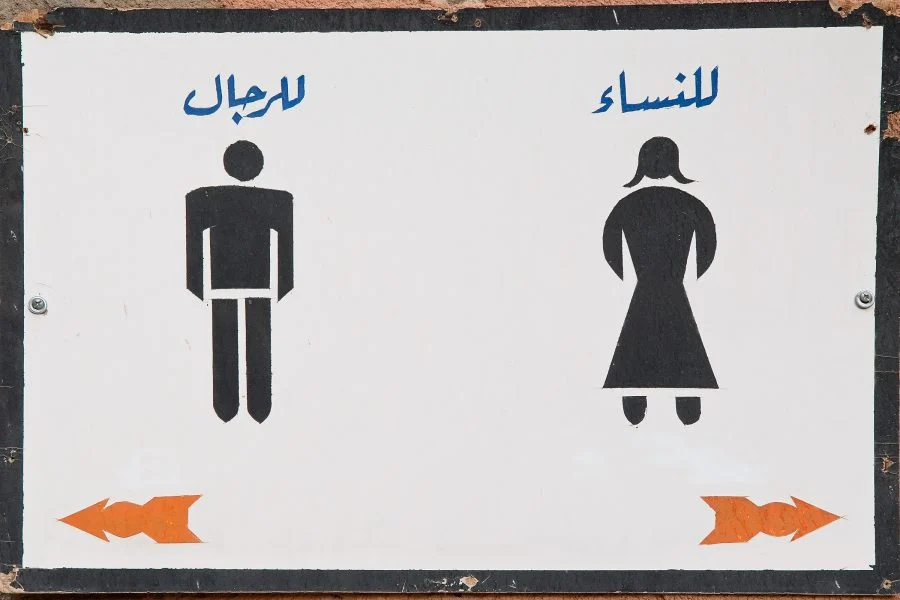
World Toilet Day arrives with new sanitation investments in Rabat and Casablanca, yet the basic act of using a public toilet still relies on attendants working long hours for small, informal payments from users.
Public toilet attendants across cities often operate without formal contracts and depend on one- or two-dirham contributions that function as de facto entry fees.
In Casablanca, workers say they spend up to 13 hours a day cleaning, monitoring and keeping facilities open, with monthly earnings that hover around 2,000 dirhams when tips are included.
Many cover basic costs themselves, and report working without health coverage or clear guidance on what they are allowed to charge.
In Sidi Slimane and Settat, workers interviewed by Hespress describe daily exposure to urine, feces, blocked drains and inadequate supplies.
“Sometimes people cooperate and give MAD 3 or 4,” said Farida Jaidi, the president of the Environmental Women Association (EWA).
But Jaidi explained that “there should be clarity. People cannot think that the toilet belongs to the attendant or that they are charging an entry fee,” adding that these attendants are normally employed by private companies that manage the toilets, not acting independently.
In practice, access varies by attendant, because while some allow entry immediately, others hold the door until a coin is offered, creating an informal system that operates independently of municipal policy.
Residents in Casablanca and Rabat say they are routinely asked to pay despite local authorities presenting the facilities as free.
“You can’t use a public toilet without paying. It’s not written anywhere, but everyone knows it,” Radia, a mother of two who lived her entire life in Casablanca before moving to Tit Mellil, told Hespress EN.
Marwa, a student in medical training, said, “Sometimes they ask explicitly for the money. And if you don’t pay, you’re not allowed to enter.”
Marwa said that she understands the nature of the job is difficult and the wages might be low,” but citizens still have a right to use public bathrooms without being forced to pay, and without being made to feel embarrassed for not doing so.”
In March 2024, local media in Rissana near Al Ar Raïch reported that a 46-year-old toilet attendant fatally stabbed a user after the latter refused to pay a one-dirham charge; a court later issued a life sentence.
In January 2023, a man in his seventies working as a toilet guard in Marrakech’s Jemaa el Fna was found dead inside the facility during his shift, according to police and municipal statements.
Public bathrooms in Morocco carry a social weight shaped by privacy norms, with many users still associating toilets with the home rather than with shared civic infrastructure.
The president of the Environmental Women Association said that Moroccans grow up in a culture where it feels inappropriate for someone to clean after you, “we even say “Hachak” to express embarrassment about anything related to dirt or bodily acts.”
“We’re raised to feel shy about someone handing us our shoes to put them on, let alone having someone clean after you in a toilet,” she said.
Public toilet attendants in Morocco belong to a global sanitation-workforce that the International Labour Organization describes as essential yet structurally under-protected.
Sociological research shows that labour associated with dirt, waste and bodily functions carries enduring stigma, placing workers at the edge of regulatory frameworks and limiting how their roles are defined or valued.
The payment system itself predates modern municipalities, with pay-to-use practices documented from Roman-era fees on public latrines to the introduction of coin-operated gates in European cities during the nineteenth century.
The practice continues to function as a gatekeeping mechanism that, according to Marwa, excludes users who cannot provide a payment, including the homeless “who often have no access to sanitary facilities but would still need to use the public restroom,” and mirrors the complaints recorded in travel guidance where visitors report being asked for coins at public toilets with no posted fees.
Complaints extend beyond the payment request itself, covering access, availability, and hygiene. Users describe long gaps in coverage in major cities, with Casablanca requiring an estimated eight thousand public toilets and many districts operating without any facilities at all.
Travel guidance flags similar problems for tourists, noting limited toilet availability in high-traffic areas and inconsistent hygiene standards between sites.
Residents point to the lack of signage explaining whether facilities are free, the absence of posted hours and uneven upkeep that leaves toilets out of service for extended periods.
Rabat is spending around MAD 20 million to build 11 “smart” self-cleaning public toilets. These toilets clean themselves automatically, use sensors, and even have LED lights. They are designed to be hygienic, modern, and easy to maintain.
The toilets will also be monitored digitally, so city managers can track usage, water and energy consumption, and know when maintenance is needed. They are built to be accessible, with ramps and wide doors for people with reduced mobility.
Rabat’s plans could reshape the entire system. But Jaidi says Morocco doesn’t have the capacity to make all public toilets self-cleaning as Casablanca alone needs around 8,000 toilets, so the job of attendants will not become obsolete.
“That’s why there needs to be an official system clearly defining the attendants’ role and how fees, if any, should be handled.”